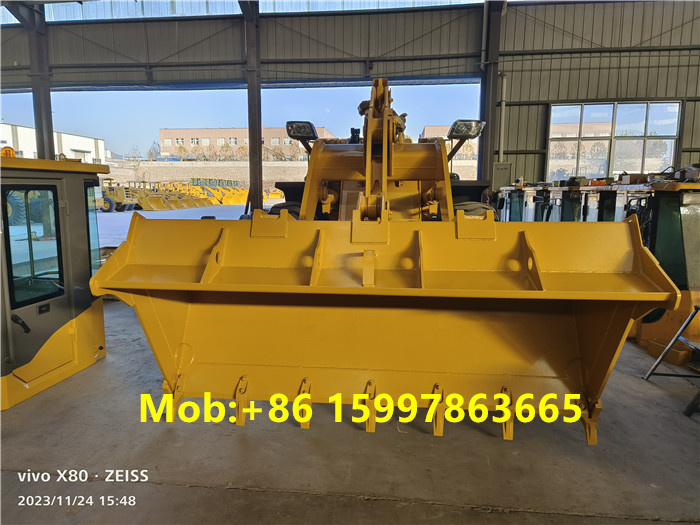
Introduction to Heavy Wheel Loader
2026-10-15
A heavy Wheel Loader is one of the most powerful and versatile machines in the modern construction, mining, and industrial material‑handling sector. Unlike smaller loaders used for light‑duty tasks, heavy wheel loaders are built specifically to move large volumes of material quickly, consistently, and under demanding operating conditions. With high bucket capacity, strong lifting capability, and a reinforced structure, these machines serve as a critical link between excavation, loading, and haulage in large‑scale projects.
What Defines a Heavy Wheel Loader?
Heavy wheel loaders are typically defined by their size, operating weight, and working capacity. They are constructed on massive frames and weigh several tens of tonnes, equipped with large buckets that can handle dense materials such as rock, overburden, demolition debris, aggregates, and ore. Their design focuses on durability, with heavy‑duty axles, robust undercarriages, and powerful diesel engines that deliver high torque and sustained performance over long working shifts.
These machines rely on advanced hydraulic systems that provide strong lifting and breakout forces, enabling them to penetrate compact or uneven material with fewer cycles. Many heavy wheel loaders adopt articulated steering, combining a rigid front‑end structure with a flexible joint between front and rear frames. This layout improves manoeuvrability on uneven terrain and confined sites while still maintaining the stability and power expected of large‑scale equipment.
Typical Applications and Operational Role
Heavy wheel loaders play a central role in large‑scale construction, open‑cast mining, quarries, and industrial material‑handling yards. They are commonly used to load haul trucks, feed crushers and screens, stockpile bulk materials, clear construction or demolition debris, and prepare surfaces for further operations. Their ability to move large volumes of material over short to medium distances makes them essential wherever speed, consistency, and uptime are critical to project timelines.
In mining and quarrying, heavy wheel loaders help maintain steady truck‑fill rates, reduce waiting time at loading points, and support continuous production cycles. In civil construction, they support earthmoving, grading, and site‑preparation activities, while in industrial environments they assist in handling raw materials, production by‑products, and waste streams. Compatibility with a range of tires, buckets, and attachments allows heavy wheel loaders to adapt to different ground conditions and material types, making them highly flexible assets on complex job sites.