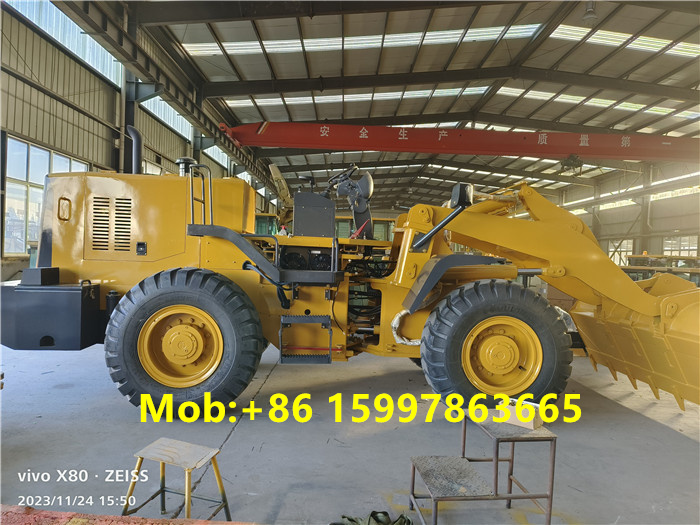
Difference Between Agricultural and Industrial Wheel Loader
2026-10-14
Selecting the right Wheel Loader can significantly influence productivity, operating costs, and equipment lifespan. While agricultural and industrial wheel loaders share a similar basic layout—front bucket, articulated steering, and four‑wheel drive—their design philosophy, build specification, and operational focus differ to suit their respective environments. Understanding these differences helps farm owners, contractors, and industrial operators choose the machine that truly fits their daily workload and long‑term business needs.
Design Philosophy and Structural Build
Agricultural wheel loaders are engineered primarily for versatility on mixed terrain such as fields, farm lanes, and small concrete yards. They tend to be lighter in overall weight and optimized for lower ground pressure, which reduces compaction on soft or cultivated soil and protects the integrity of farm land. Their chassis is designed to work efficiently at moderate speeds over uneven, often muddy surfaces, with tires that offer a balance between traction and field‑friendly contact area.
Industrial wheel loaders, by contrast, are built for durability under heavy, continuous loads. Their frames, axles, and attachments are reinforced to withstand abrasive materials like crushed stone, demolition debris, scrap metal, and industrial by‑products. The structure is often more rigid, with stronger booms, heavier‑duty pins, and robust hydraulic components that can handle aggressive loading cycles and frequent impact shocks without compromising reliability.
Power, Hydraulics, and Operating Performance
In agriculture, wheel loaders typically use engines and hydraulics that match the workload of loading grain, silage, manure, feed, and bales. Power output is sufficient for frequent, but not extreme, lifting and loading, with hydraulic systems tuned for smooth, controlled operation rather than maximum breakout force. Speed and cycle times are adequate for farm‑scale operations where the priority is practicality and fuel efficiency, not maximum throughput.
Industrial machines, however, are designed for higher power density and faster cycle times. They combine stronger engines with higher‑pressure hydraulic systems that deliver greater lifting and breakout forces, enabling operators to penetrate dense or compacted material and load trucks, hoppers, or conveyor feeders more quickly. This makes them suitable for continuous, high‑intensity operations in construction yards, quarries, manufacturing plants, and logistics hubs where uptime and throughput are critical.
Typical Applications and Work Profiles
Agricultural wheel loaders are commonly seen in dairy farms, crop farms, feed mills, and poultry operations. They are used to fill feed wagons, load and unload grain from storage, move manure, clean sheds, stockpile bales, and transfer processed crops. Their compact size and manoeuvrability make them ideal for working in narrow lanes, small yards, and around storage structures where space is limited, yet productivity per hour still matters.
Industrial wheel loaders, on the other hand, are deployed in construction sites, warehouses, crushing plants, and material‑handling yards. They handle bulk aggregates, demolition waste, industrial raw materials, and production by‑products, often feeding trucks, grabs, or conveyor systems in a tightly coordinated workflow. Their higher loading capacity and faster cycle times help keep production lines moving and reduce waiting time for supporting vehicles.
Operator Comfort, Safety, and Maintenance
Both machine types increasingly prioritize operator comfort, with spacious cabins, good visibility, and ergonomic controls. Agricultural loaders often emphasize ease of use and simple maintenance, since many farms operate with limited technical support. Side‑boarding attachments, quick‑attach systems, and straightforward service points make them practical day‑to‑day tools for farm owners.
Industrial loaders usually place a stronger focus on safety and monitoring systems, given the more complex, multi‑machine environments in which they operate. Features such as reinforced rollover protection, enhanced visibility, obstacle detection systems, and integration with telematics platforms help operators move heavy material safely and allow fleet managers to monitor performance, fuel consumption, and maintenance intervals remotely.